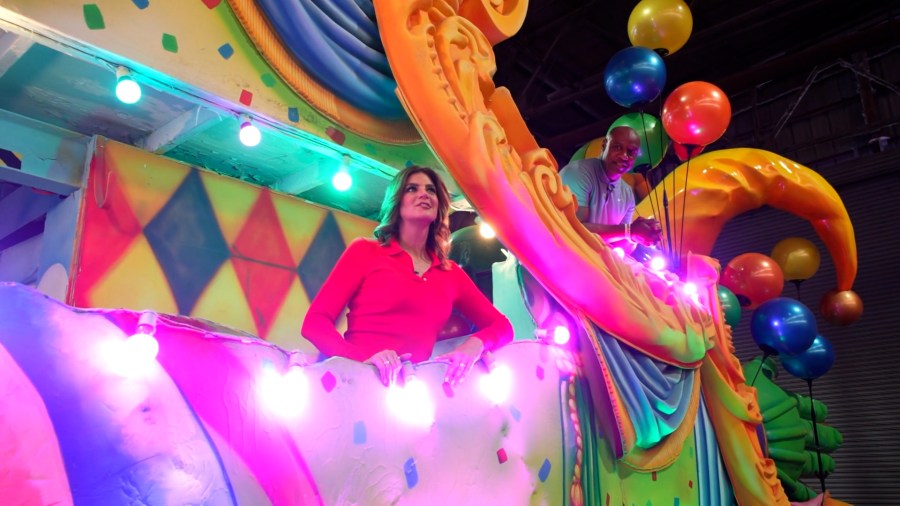
(NEXSTAR) — For anyone who has ever wondered how the giant floats featured in Mardi Gras parades are created, Mardi Gras World in New Orleans offers a behind-the-scenes look at the artistry and craftsmanship behind the city’s legendary celebrations. The facility, operated by Kern Studios, spans 250,000 square feet and is one of 20 warehouses in the city where Mardi Gras floats are designed, constructed, and stored.
Founded by Roy Kern over 90 years ago, Kern Studios remains a family-run business and continues to shape the spectacle of Mardi Gras. Forty years ago, the studio began welcoming the public to experience the float-making process firsthand. Visitors can tour the facility to see the elaborate floats, props, and intricate details that bring the parades to life.
“I think it’s a lot like asking a parent who’s their favorite child,” said Fitz Kern, a fourth-generation float maker at Mardi Gras world, when asked if he had a favorite float. The studio houses a mix of signature floats, which remain the same each year, and new creations. About 10-15% of floats fall into the Signature category, like the Pegasus float, known for its animated design and lightweight carbon-fiber structure.
“Because the weight of those pieces cantilevered out was so heavy, we actually had to create a mount of carbon fiber like you would a race car in order to get that much weight out at that angle,” Kern explained. “And so that’s just one of those funny problems you don’t think about when … you watch these things come down the street.”

The process of crafting floats is as diverse as the floats themselves. Some are sculpted by hand, starting with six-inch sheets of foam that are shaped into detailed designs. For others, fiberglass is often used for pieces expected to endure years of use. “We know we’re gonna use these guys a lot and so we make ’em out of fiberglass, which is a little bit of extra cost,” Kern added. “But we know that we can give these guys a little bit of muscle and nothing’s going to happen to ’em.”
Mardi Gras is more than a single parade—it’s a citywide celebration spanning two weeks. “There’s over 30 parades over that two week period preceding Mardi Gras day. And so on our biggest day, we have 210 floats all in different parts of the city,” Kern said. “That’s over 10,000 riders throwing beads in different neighborhoods around the city. So it’s a lot of fun and that’s why we call it the best free show on earth.”