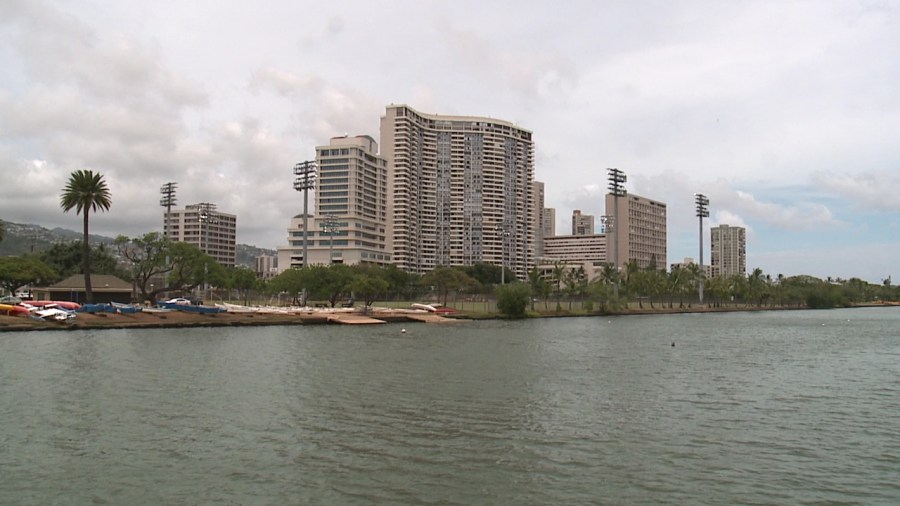
HONOLULU (KHON2) — Multiple grants totaling $200,000 look to transform the Ala Wai Canal.
The University of Hawaii’s Sea Grant College Program awarded six awards between $10,000 and $50,000 for projects to improve water quality, enhance ecosystem resilience and engage communities in sustainable solutions.
It’s all part of the Ola Waikiki project, which hopes to create strategies that “mimic nature to manage and treat stormwater.”
According to Hawaii Sea Grant Director and Principal Investigator Darren T. Lerner, the increased number of storms calls for sustainable long-term management of the Ala Wai and its watersheds.
“These projects provide an opportunity to demonstrate small-scale application of GSI that can eventually be scaled up into regional projects that support meaningful and impactful benefits to the environment and community,” Lerner said.
A Hawaii Sea Grant panel funded the following community-led projects for the effort:
Aliʻiolani Elementary School Cafeteria Rain Garden
The project aims to install a rain garden, which would capture about 80,000 gallons of rainwater each year.
The garden will also serve as an educational tool for students and the Palolo community.
Increasing Urban Tree Canopy at Jarrett Middle School
Community members plant trees to help mitigate flooding impacts and reduce stormwater runoff in Palolo Valley.
The shade trees would double as an on-campus arboretum for keiki to learn about native tree species and sustainability.
M&M (Maintaining & Monitoring) the Kaimukī Rain Garden
It’s an addition to an already existing rain garden on 11th Ave.
Volunteers will get the opportunity to learn about groundcover plants and participate in hands-on sustainability practices.
Pālolo Hongwanji Sustainable Community Hub
University of Hawaii officials said this project would intercept stormwater for treatment before it reaches the Palolo Stream and the Ala Wai Canal.
The suite would feature rain barrels and rain gardens to do this.
Pu‘uhonua: Distributed, Scalable Phytoremediation
Community members will use Native Hawaiian plants to deploy floating wetlands in the Ala Wai Canal.
The wetlands will “improve water quality, enhance biodiversity and explore cost-effective ecological restoration methods.”
Restoring Roots at Puʻu o Kaimukī Mini Park
Volunteers will create a more resilient urban ecosystem through erosion control and native biodiversity restoration.
The prioritization of this would help reduce runoff and promote traditional ecological knowledge.
Check out more news from around Hawaii
For more information on these projects or to get involved, click HERE.