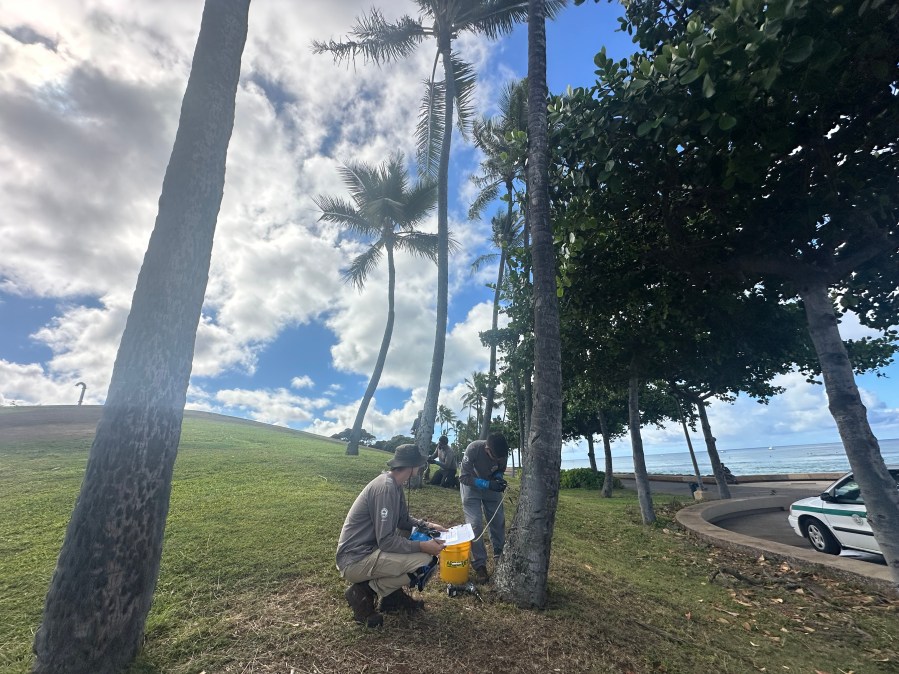
HONOLULU (KHON2) — If you see workers injecting coconut palms at parks in Honolulu, don’t be alarmed — it’s part of a preventative treatment to protect the trees from the invasive Coconut Rhinoceros Beetle (CRB).
Roughly 800 palms in parks from Kakaako to Ala Moana are being injected with Xytect insecticide, which is designed to protect them from the invasive beetles. According to the Division of Urban Forestry (DUF), palms will be receiving the injections at the following parks:
- Kaka‘ako Water Front
- Kaka‘ako Gateway Makai
- Kaka‘ako Gateway Mauka
- Kewalo Basin Park
- Ala Moana Regional Park
KHON2 spoke with Nate Serota, a spokesperson with the Department of Parks and Recreation, about the treatment, which costs about $300 per tree.
“A reason we haven’t been able to do it on the other hundreds and thousands of palms on the other side of the island is it’s really cost prohibitive,” Serota said.
Roxanne Adams, the head of Honolulu’s DUF and its lead arborist, said the treatments aim to prevent the beetles from making it into the “dense groves” of palms that is concentrated from Moanalua to the Ka Iwi Coast.
“The urban core is easier for us to protect,” Adams told KHON2. “It has a higher concentration of palms and doesn’t have debris that is found in rural areas.”
Officials said the trees at public parks are already well-maintained for public safety reasons, and all trees must be clear of coconuts and flowers before being injected.
The treatment has to be reapplied annually. For now, the city said it has a four-person crew committed to doing the injections year-round.
“We’re hoping that additional funding for biosecurity moving forward is going to be something we can do to maintain this partnership until we can find landscape level control to manage CRB moving forward,” explained Jonathan Ho, Department of Agriculture’s Plant and Quarantine branch.
Experts said the best natural treatment is managing green waste.
“Areas with a lot of breeding material are a huge problem for treatment,” explained Keith Weiser, Deputy Incident Commander CRB Commander. “Even if you’re using pesticide, so getting green waste under control is really one of the best things.”
He said other islands need to make sure they are not moving infested material to non-impacted areas, and they have been fumigating shipments from Oahu to help stop the spread.
To learn more about the existing treatment options to fight CRBs in Hawaii, visit crbhawaii.org. If you see an invasive species or damage from an invasive species, call 808-643-PEST (7378) or report the sighting at 643pest.org.