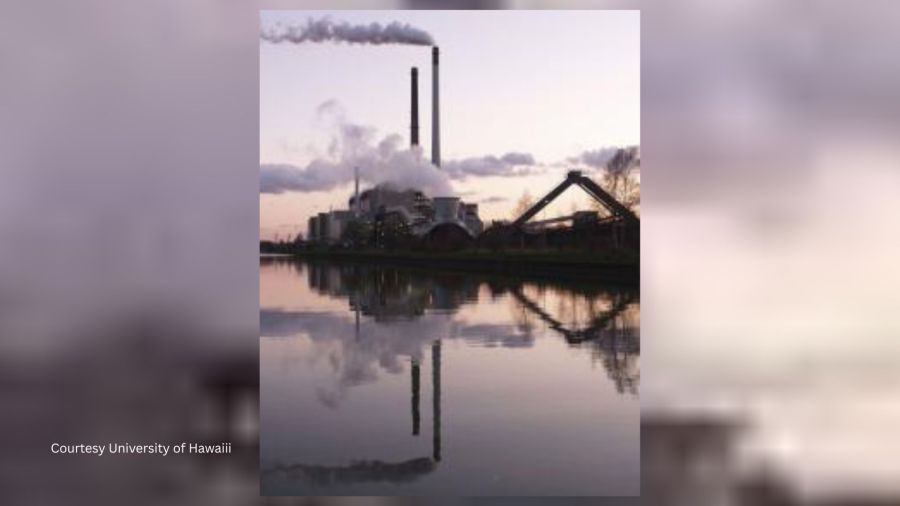
HONOLULU (KHON2) — Even if you are far from a factory, the ocean can still feel its smoke. A new study led by scientists at the University of Hawai‘i at Mānoa shows that iron from burning coal and making steel is drifting into the North Pacific Transition Zone, just north of Hawai‘i, changing the way life works here and the health of our entire ecosystem.
This ocean region is a key part of the Pacific food web. It’s where tiny ocean plants called phytoplankton grow each spring, and these phytoplankton feed many fish and other marine animals.
Iron is a key nutrient for phytoplankton; but too much of it, especially from human activity, is throwing things out of balance.
Here’s what the UH study has found:
Iron fuels growth but leaves hunger behind
Each spring, the phytoplankton in our part of the ocean are hungry for iron. When extra iron enters the water, it sparks a big bloom of growth. At first, that may sound like a good thing; but it comes at a cost.
When the bloom happens too fast, other nutrients in the water get used up too quickly. That makes the bloom crash later in the season. When the bloom prematurely collapses, it harms fish and the fisheries that depend on them.
A boundary moves farther away
Nick Hawco, assistant professor in the Department of Oceanography at UH Mānoa, explained how these changes affect life across our ocean.
“The ocean has boundaries that are invisible to us but known to all sorts of microbes and animals that live there,” Hawco said. “The North Pacific Transition Zone is one of these boundaries. It divides the low nutrient ocean gyres from the high nutrient temperate ecosystems to the north.”
The added iron causes that boundary to shift north. As the ocean also gets warmer, the waters rich in phytoplankton are moving farther away from Hawai‘i.
“It’s a one-two punch: industrial iron is impacting the base of the food web and the warming of the ocean is pushing these phytoplankton-rich waters further and further away from Hawai‘i,” Hawco said.
What USC has found
A study led by the University of Southern California (USC) investigated how industrial emissions from East Asia, particularly from coal-fired power plants, contribute iron to the North Pacific Ocean and how this is affecting marine ecosystems.
Here’s what they found:
- Iron can travel thousands of miles: The research demonstrates that iron particles from industrial emissions in East Asia can be transported across the Pacific Ocean by westerly winds where the iron is deposited in the North Pacific Ocean.
- Industrial iron isn’t the same as natural iron: Scientists identified that the iron found in the ocean matched the isotopic signature of industrial emissions, distinguishing it from natural sources like mineral dust.
- Phytoplankton are small but powerful: Phytoplankton, the microscopic plants in the ocean, form the base of the marine food web. The study highlights that increased iron availability can stimulate their growth, which is crucial for marine ecosystems and global carbon cycles.
- The ocean has invisible boundaries: The introduction of iron into the ocean can shift ecological boundaries and affect nutrient distribution and marine life. The study notes that such changes can impact the North Pacific Transition Zone, which is a critical area for marine biodiversity.
- Fisheries near Hawai‘i could suffer: The research indicates that the influx of iron could alter phytoplankton distribution. This can potentially affect fish populations and fisheries near Hawai‘i.
You can click here for the UH study and here for the USC study.
Both of these studies underscore the complex and far-reaching impacts of industrial pollution on marine ecosystems, even in remote regions like Hawaiʻi.