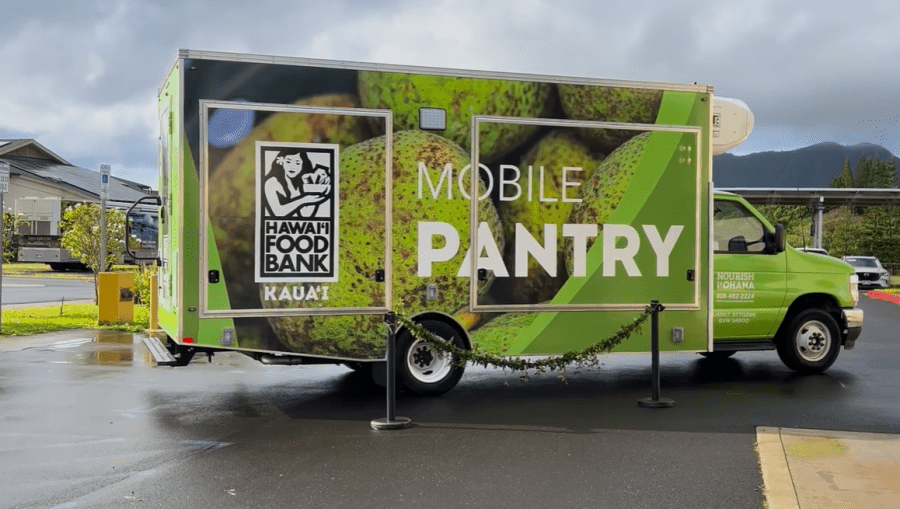
HONOLULU (KHON2) — Hawaii Foodbank is finding ways to better support people facing food insecurity. On Tuesday, June 24, Hawaii Foodbank Kauai hosted a blessing and launch event for their new mobile food pantry.
“It’s like a store on wheels,” said Wes Perreira, the Kauai branch director of Hawaii Foodbank, Inc.


“One of the things that it’s designed for is to be able to take the food directly to people who may have trouble with access,” said Perreira. “We learned from the floods and disasters in the past that the way Kauai has been designed, we need to be able to get the food to the people.”
The 16-foot refrigerated truck will expand distribution services of nutritious, culturally relevant foods to rural and underserved communities across the island. Accessibility and client choice are prioritized by the mobile food pantry.
“Find the gaps of where we are not meeting the people like how we are supposed to be,” Perreira said, recalling a statement made by Amy Miller, President and CEO of Hawaii Foodbank, Inc.
Feeding America attributes over 20 million pounds of food distributed annually by Hawaii Foodbank, Inc. to people facing hunger. Affiliate food banks are The Food Basket, Inc., located in Hilo and Maui Food Bank, located in Wailuku.
Hawaii Foodbank, Inc. serves the following counties: Hawaii, Honolulu, Kalawao, Kauai and Maui. In these areas, one in seven people struggles with food insecurity, and one in five keiki face hunger.
Food bank vs. food pantry
According to Feeding America, a food bank stores food and hires drivers to make deliveries to local food programs. Food banks are non-profit with donations provided from local neighbors, retailers, grocery stores and restaurants.
A food pantry is supplied by a food bank. Pantries aim to be accessible to the community. A distribution center is where people receive food, which can be located in schools or as mobile pantries.
Food assistance programs
There are three federal food assistance programs in Hawaii administered by the Office of Community Services under the direction of the Food and Nutrition Service of the U.S. Department of Agriculture (USDA).
Commodity Supplemental Food Program
- Low-income kupuna at least 60 years of age can receive a box of nutritious USDA foods.
Senior Farmers’ Market Nutrition Program
- During the “harvest season” of April 1 to Oct. 31, low-income kupuna can receive eligible foods (fruits, vegetables, honey and fresh cut herbs) from authorized farmers, farmers’ markets and roadside stands.
The Emergency Food Assistance Program
- Low-income residents can receive emergency food and nutrition assistance at no cost.
For more information on eligibility and participation in these programs, visit HERE.