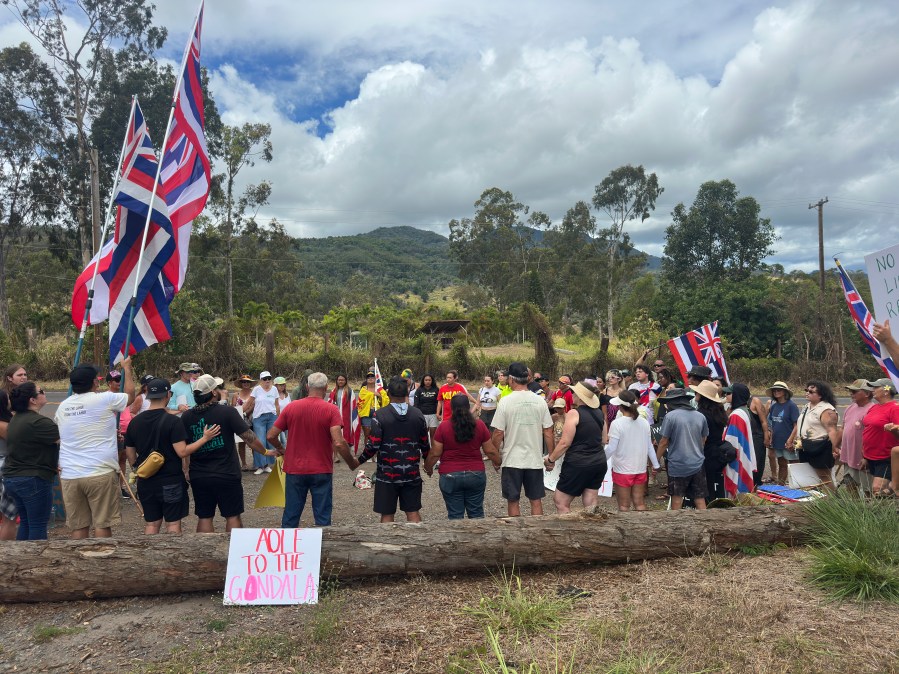
WAIALUA (KHON2) — About 100 people gathered on Oʻahu’s North Shore Sunday to protest a controversial agritourism development proposed by Kaukonahua Ranch—one that would include a gondola, zipline, and other activities on Mt. Kaʻala, the island’s tallest peak.
The project has drawn sharp criticism from residents and local officials, who say the development threatens agricultural land use and community safety.
“The traffic right here would be horrendous,” said former State Senator Gil Riviere who represented North Shore. “This is the most dangerous road on the island.”
According to HPD releases, there have been three fatal crashes on Kaukonahua Road in the last three years. The latest one occurred on April 15, 2025.
According to Emergency Medical Services, paramedics have responded to 10 crashes on the four-mile stretch of road in the last five years, and had to transport multiple patients in critical or serious condition.
Kaukonahua Ranch, which acquired 2,300 acres from Dole Food Company in 2017, said it currently operates as a working cattle ranch and cultivates crops including papaya, ulu, bananas, dragon fruit, and mushrooms. It has also launched reforestation initiatives with koa, sandalwood, and lama trees.
In 2019, the Department of Planning and Permitting approved a Conditional Use Permit for the ranch’s agribusiness concept, which included gondolas, ziplines, hiking trails, and more.
The ranch is now seeking minor modifications to that permit, which it says will reduce the project’s footprint including cutting the number of gondola stations from 18 to eight; reducing ziplines from four to one; and making the zipline length 5,000 feet instead of 8,000 feet.
The highest gondola elevation would be 1,250 feet, which is lower than Mt. Kaʻala’s 4,000-foot summit and roughly 2.5 miles away, according to the developer.
Despite the changes, many community members remain deeply opposed. Protesters gathered across the street from the proposed development site on Kaukonahua Rd, citing safety, cultural, and environmental concerns.
“For me, the mountain is a protection for Waialua,” said lifelong resident Melvin “Moki” Labra. “People ask me, ‘Uncle, were you mad [when you heard about the project]?’ I said no—I was furious. I only learned about this a month ago and later learned it was introduced back in 2018. I’m offended the word didn’t come out to us.”
Many others said they only recently learned of the scope of the project, despite claims from the developer that outreach has been ongoing since 2017.
“They’ve had five or six years to engage with our community, and they haven’t at all,” said Racquel Achiu-Hill, North Shore Neighborhood Board Vice-Chair. “There has been no engagement.” She said there were a few ‘controlled visits’ to the site, but they did not include the community.
Earlier this month, more than 100 residents attended a community meeting, but representatives from Kaukonahua Ranch did not attend, citing scheduling conflicts.
City Councilmember Matt Weyer explained that under Honolulu’s Land Use Ordinance, agritourism is allowed as an accessory activity on agricultural land—if at least 51% of the land remains in active agricultural production.
Check out more news from around Hawaii
Kaukonahua Ranch says the project would provide over 200 jobs and protect agricultural lands from future subdivision or residential development.
In a statement, Kaukonahua Ranch said, “We remain committed to being good community stewards for Kaukonahua Ranch. We continue to focus on enhancing our cattle ranching and crop-growing operations, the reforestation of native trees, and creating an agricultural based model that is in keeping with the rural qualities, unique country feeling, and agricultural history of the north shore.”
“The CUP of our agribusiness project requires us to meet many conditions and our team has been working hard to fulfill these requirements. Amidst that process, we determined a number of important refinements in the scope and intensity of the project that we recently shared in our submission for a minor modification application that details how we have significantly reduced the scale and scope of our agribusiness project. We are still awaiting a decision from the City and County of Honolulu’s DPP.”
“We look forward to sharing the latest details of our project with the community and how it will support the future of Kaukonahua Ranch, create more local jobs, and foster community partnerships and opportunities.”
But critics like Riviere argue that the agritourism elements are far more central to the plan than the agriculture itself.
“The whole purpose of this project is to build this massive tourist attraction under the guise of supporting agriculture and that’s completely abusing the intent of the law,” Riviere said. “It completely abuses the intent of the law.”
The Department of Planning and Permitting is still reviewing the ranch’s modification request and says not all conditions of the original CUP have been met.
A joint neighborhood board meeting will be held on July 30 at Leilehua High School, bringing together representatives from Mililani, Wahiawā, North Shore, and Mililani Mauka to discuss the project and gather more public input.
“You do it on this side, and who’s to say it won’t happen on the other?” said Kimo Baker, a Nānākuli resident. “That side is just as beautiful.”
The ranch argues that a gondola system provides the lowest ecological footprint for accessing areas mauka.
Still, many in the community say they will continue to oppose the project until the gondola and zipline plans are completely dropped.