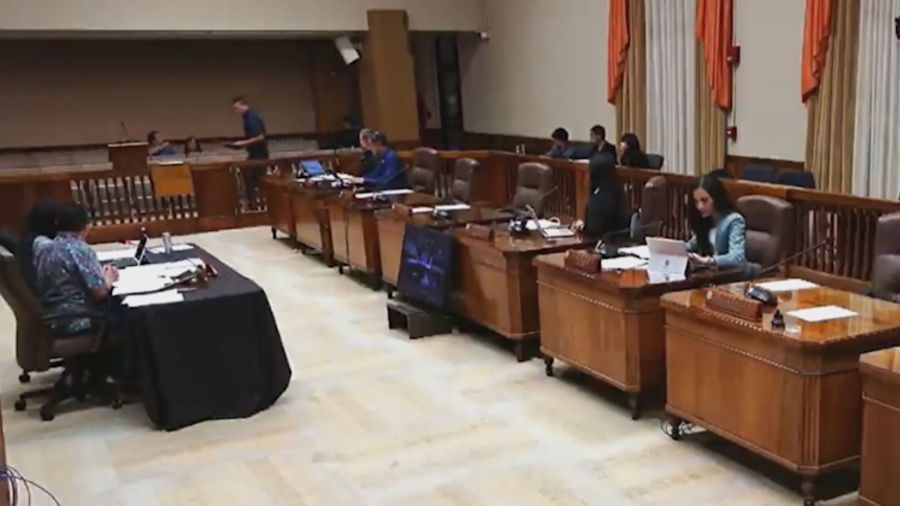
HONOLULU (KHON2) — The Honolulu City Council discussed Bill 46 with community leaders on Thursday, July 24, discussing whether the City Council needs to give verified news media real-time access to the Honolulu Police Department’s (HPD) radio communications.
Supporters of the bill said it promotes public safety and transparency. However, police leaders worry it could put officers and investigations at risk.
Interim Chief of Police Rade Vanic said he supports transparency but warned that releasing live radio traffic could harm public and officer safety.
“If I got to switch channels and I got to take my eye off this person. That gives that person an opportunity to be aggressive towards me,” Vanic said.
He explained that officers in Honolulu often work alone, unlike in some mainland cities.
“When you’re operating with a partner, you can tell your partner, ‘While I’m watching this guy, you go run this guy.’ That’s fine. That’s great. But I can’t do that if I’m by myself.”
Vanic said giving real-time access to radio communications could lead to delays in response or confusion during emergencies.
Councilmember Tommy Waters said the bill would push police and media to come together.
“Bill 46 is that incentive to get everybody to the table,” Waters said. “If you folks come up with a written agreement, we don’t need the bill.”
Councilmember Radiant Cordero suggested a compromise.
“I do think that a written agreement between the media as well as the police department would help alleviate certain concerns,” she said. “It doesn’t have to be something like an RFP or a contract. But a written agreement could help in that manner.”
Councilmember Val Okimoto asked if other cities had tried this before.
“Are there cities and situations where they did do this and it turned out positive?” she asked.
Vanic responded, “I know of one department that has done it.” When asked about the result, he said, “They wish that they didn’t do it. That’s all I know.”
Chris Leonard, general manager at the Hawaii Association of Broadcasters, spoke in favor of the bill.
“I want to be clear that journalists aren’t listening to scanners to sensationalize. We’re using that information to mobilize their staffs to verify facts, to get accurate updates out quickly, Leonard explained. “The concerns about officer safety, tactical safety, protecting personal information, PII, as it is referred to, are absolutely valid, especially in today’s world. But there are solutions, credentialed access, encrypted tactical channels, audit trails.”
He said the public deserves timely and accurate information.
Vanic said he is open to releasing limited information but does not support giving full access to radio transmissions.
“We are able to share information not only to the media, but the public,” he said. “We could share general locations, the type of case, like an assault, when they’re going, when they get there, that kind of stuff.”
He added, “I would still want some type of delay, so our officers can get there, they can make the scene safe and still allow the media to do their job.”
Vanic also raised legal concerns.
“There’s a section that talks about who is eligible, and the definition talks about having a law enforcement nexus. Unfortunately, the media doesn’t fall under that,” he said. “We still could face sanctions.”
Waters asked councilmembers to move the bill forward for more discussion.
“We need to have that information in order to make informed decisions,” he said. “The bill is there to kind of make you guys work it out.”