Video above: Can the NFL do more to prevent concussions?
NEW YORK (WPIX/NEXSTAR) — Authorities say Shane Tamura, the man accused of fatally shooting four people in a Manhattan office building before turning the gun on himself on Monday, claimed to suffer from a serious brain disease in a note he left behind.
Mayor Eric Adams said Tamura, 27, apparently had a grievance with the NFL over his own belief that he had suffered CTE. Tamura played high school football in Los Angeles, according to ABC News, but did not play in the NFL, whose headquarters are located in the Midtown skyscraper.
CTE, short for chronic traumatic encephalopathy, is a disease that impacts how the brain functions. According to the Centers for Disease Control and Prevention, CTE has been “linked to a build-up of abnormal proteins that damage brain tissue and cause brain cells to undergo cell death.”
Often linked to NFL players, CTE is often associated with “repeated hits to the head,” the CDC explains. Research has yet to uncover how CTE starts, whether there are potential risk factors that can increase a person’s chance of developing CTE, and why some people with repeated hits to the head don’t experience the disease.
Scientists have also not been able to identify the specific symptoms of CTE. However, many of the NFL players who were diagnosed with CTE were described as having struggled with their mental health before their deaths.
The only way to confirm the existence of CTE is by performing an autopsy of a person’s brain after they die.
Tamura’s suicide note mentioned former NFL star Terry Long, who committed suicide in 2006 by drinking antifreeze and was later diagnosed with CTE.
Nearly 400 former NFL players diagnosed with CTE
Several other former NFL players have been diagnosed with CTE in recent years. A 2023 report said of the 376 former NFL players studied by Boston University’s CTE Center, 345 had been diagnosed with the brain disease.
In 2011, former NFL safety Dave Duerson died of a self-inflicted gunshot wound to the chest. According to the Los Angeles Times, he asked his family to donate his brain to Boston University for testing. He was later found to have suffered from CTE.
In 2013, the family of confirmed that former NFL linebacker Junior Seau, who took his own life the year prior, suffered from CTE. He was reportedly unable to sleep in the years before his death, which resulted from a gunshot wound to the chest.
Ken Stabler, the former NFL quarterback who died in 2015 after being diagnosed with Stage 4 colon cancer, was also found to have Stage 3 CTE. His longtime partner told ESPN’s “Outside The Lines” that Stabler had “severe” headaches, forgetfulness, disorientation, and trouble sleeping before his death.
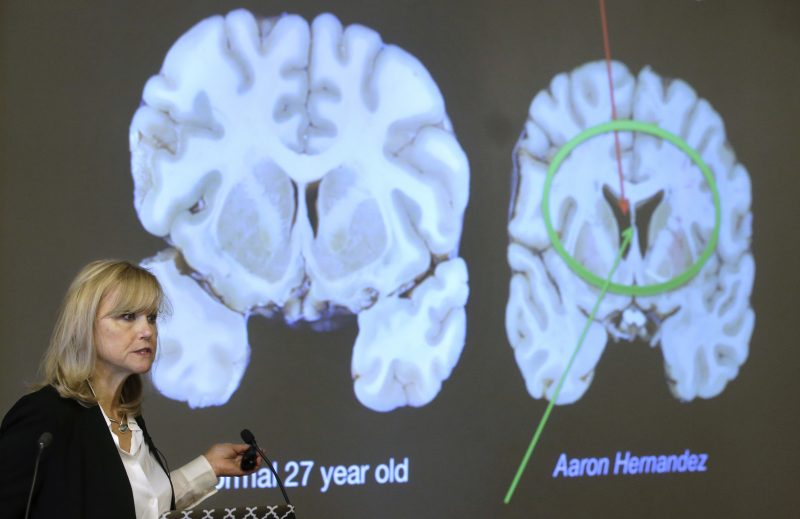
Aaron Hernandez, whose 2017 death was ruled a suicide, was found to have Stage 3 CTE, commonly associated with memory loss, behavioral changes, and impaired judgment. He had been in prison at the time of his death in a murder case.

Irv Cross, a former NFL player turned CBS anchor, was found to have had CTE following his 2021 death. His widow, Liz Cross, told the Associated Press in 2023 that the former Philadelphia Eagles cornerback had experienced depression, mood swings, and memory loss that made him not “want to be with people.” Boston University researchers determined Cross had Stage 4 CTE, the most advanced stage, which also caused him to struggle with his balance and paranoia.
Phillip Adams, who spent several seasons in the NFL, fatally shot six people in Rock Hill, South Carolina, before killing himself in 2021. An autopsy later showed he had Stage 2 CTE, a severe form known to cause violent mood swings and memory loss, Nexstar’s WJZY reported. In 2023, his father sued South Carolina State University, accusing the school of failing to protect players and educate them about head injuries.
Former NFL Pro Bowl wide receiver Demaryius Thomas, had been dealing with depression, anxiety and other CTE symptoms at the time of his 2021 death. His family later confirmed Thomas had Stage 2 CTE.
Former Tennessee Titan Frank Wycheck, who died in 2023, had Stage 3 CTE, his family said in January. He died at the age of 52 after apparently hitting his head in a fall at home. He had made clear his wishes to work with experts for CTE research and on-going brain injury.
“My dad explained that it felt like his brain had a thick brick wall inside that stopped his will to follow through with anything, no matter what it was or who was involved,” Madison Wycheck Nowell said in a statement, describing Wycheck’s condition.
Some former athletes, like NASCAR driver Dale Earnhardt, Jr. and U.S. women’s soccer player Brandi Chastain, have pledged to donate their brains to researchers after their deaths.
There is currently no cure for CTE.
The Associated Press contributed to this report.