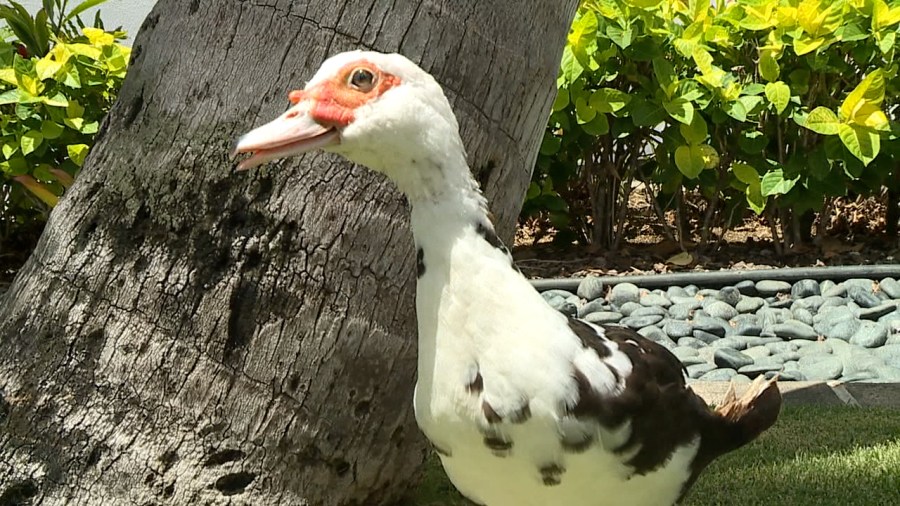
HONOLULU (KHON2) — It’s been eight months since the Avian Influenza scare swept through the state. The bird flu hit Susie’s Duck Sanctuary in Wahiawa hard, and hundreds of ducks, geese, and other birds had to be euthanized to prevent further spread.
KHON2 met Susie’s Duck Sanctuary owner, Susan Wilkinson, in November, and she was devastated when lab tests came back positive for bird flu, marking the first time it had ever been detected in the state.
She said she had about 100 birds on her property, and all of them had to be put down.
Today, she has left the Wahiawa location and is somewhere new, slowly figuring out her next steps, healing, and still trying to help the community and ducks.
“I’ve just been healing, growing, rethinking, re-figuring out how it looks with the sanctuary moving forward and how to help,” Susan Wilkinson told KHON2 on Friday from her new location.
She said she left the country for a while to figure out what to do next, and she debated whether or not to open a new sanctuary. For now, she is helping a limited number of ducks until they can be adopted.
“[At the time], I had come to the realization that I found my purpose and then that happened and I wondered if it was time to change, but while I was taking that time off, I was still helping a ton of people so the need was still there and the support,” she said.
Wilkinson’s not ready to share her new location because she’s hoping she can get nominated with Love’s Bakery ‘Spirit of Giving’ campaign, which awards several local non-profits up to $50,000. Customers can nominate their favorite local non-profits on the Love’s Bakery website until August 10.
“That would be life-changing,” she said. “Because with everything that happened, I’ve had to start over and everything is new.”
She said she’s beyond relieved no new cases have popped up since November. “Every day I breathe a sigh of relief,” she said.
Recently, the state health department surveyed about 400 individuals and found that the majority of flock owners are unaware of what to do if bird flu resurfaces.
“I’m on high alert on everything,” Wilkinson said. “But I think the best thing you can do is have a protocol ready so if any signs come up. Preparing is the best thing to do; it’s too late once it hits.”
The DOH survey found most residents statewide who owned flock were aware that bird flu had been detected in Hawaiʻi, and two-thirds of flock owners were aware of best practices.
Check out more news from around Hawaii
Among the findings:
About two-thirds of backyard flock owners reported they were not at all familiar with the U.S. Department of Agriculture’s Defend the Flock recommended practices to prevent bird flu.
Two-thirds of survey respondents also reported not knowing how to properly and safely remove and dispose of dead birds.
Most respondents (84%) were aware that bird flu had been detected in Hawaiʻi, and of the H5N1 variant that causes the flu.
Most respondents (72%) said they were very or somewhat concerned about the bird flu.
The top source of health information for the majority (76%) of Hawaiʻi residents is their doctor, which they ranked as very or somewhat trustworthy.
In total, there were 420 survey responses. Of the 420 total responses, 237 respondents met the survey eligibility criteria and completed the survey entirely. Respondents participated from five islands in the state of Hawaiʻi: 43% from Hawaiʻi Island, 35% from Oʻahu, 10% from Kauaʻi, 10% from Maui, and 2% from Molokaʻi.
The report of DOH Bird Flu Survey findings is published on the DOH website, along with more information on bird flu.
The DOH said H5N1 bird flu virus has been circulating worldwide, causing outbreaks in poultry and dairy cows in the U.S. A limited number of human cases have occurred in 2024 and 2025. Health officials remind people that bird flu is very contagious among birds and can cause severe illness among poultry, other animals and humans. At this time, officials said the risk to the general public in Hawaii and the U.S. remains low.
In terms of bird flu preparedness, DOH’s priorities include understanding Hawaiʻi residents’ awareness and needs around bird flu (through the DOH Bird Flu Survey), conducting disease surveillance by analyzing wastewater treatment plant samples collected across all counties, and having regular meetings with federal, state and local work partners to stay up to date on disease detections and public health guidelines.
Bird flu was also confirmed in a wild duck on O‘ahu’s North Shore in November 2024. The duck survived. The state health department says surveillance for H5N1 in humans, wastewater, and birds continues on all islands and no human cases have been identified to date.
Susie’s Duck is looking for volunteers, board members and people to help adopt some ducks.
You can find more on her cause here.
On the DOH Avian Influenza website, there is general guidance on what the public can do to reduce the risk of being infected with bird flu under the Prevention section. People are encouraged to avoid touching sick or dead birds, avoid drinking raw milk, and report groups of sick or dead birds to the Hawaiʻi Department of Agriculture & Biosecurity.
The DOH said backyard flock owners should look at “Defend the Flock” which includes tips on how people can prevent bird flu.