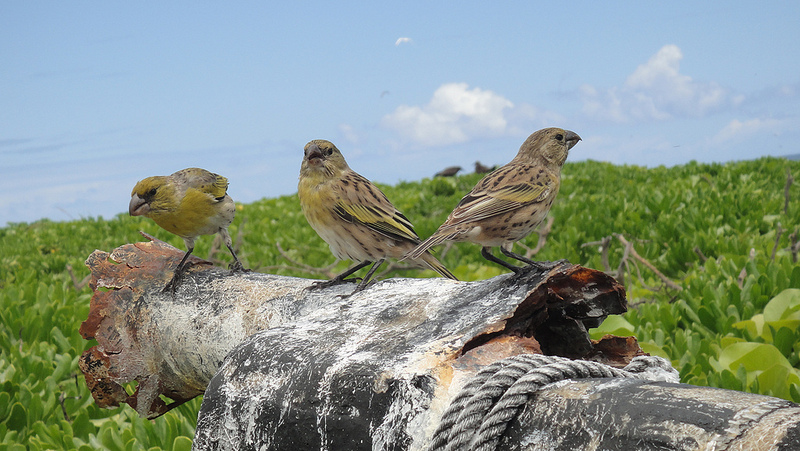
HONOLULU (KHON2) — An endangered finch is once again calling Kuaihelani, also known as the Midway Atoll, home after being away from its home for 80 years.
On July 21 and July 22, U.S. Fish and Wildlife Service staff and their partners released 100 ʻekupuʻu at the atoll, allowing the finch species to grace the area’s skies for the first time in almost a century.
The bird species once thrived at Kuaihelani until the mid-1940s, but the Fish and Wildlife Service says the creatures were extirpated due to the introduction of invasive rats that were accidentally brought to the island.
The translocation of the ʻekupuʻu is part of a continuing plan to re-establish native bird populations in the region in preparation for catastrophic events.

For endangered species, an event such as a severe storm, introduction of invasive species or a fire could be the difference between endangerment and extinction — and officials want to buff up the local populations to prevent a total erradication.
“Increasing the population size and range of these endemic species is critical to the survival and recovery of those species,” said Jared Underwood, superintendent for the Papahānaumokuākea Marine National Monument. “We feel honored and grateful that this particular translocation was brought to fruition thanks to the expertise and dedicated support from 10 different partners from non-governmental organizations, Hawaiʻi academia, State of Hawaiʻi and federal sectors.”
The preservation efforts are conducted jointly between the NOAA National Marine Fisheries Service, Papahānaumokuākea Marine National Monument, Midway Atoll National Wildlife Refuge/Battle of Midway National Memorial and several other partners.
The birds selected to relocate to Kuaihelani were chosen from the neighboring atoll of Manawai, also known as the Pearl and Hermes Atoll. The ʻekupuʻu were captured and banded with unique colored bands, and then made their way over to their new home.
The ʻekupuʻu will be monitored by a team of biologists to properly document how they will adapt to their new homes. A fifth of the birds have radio transmitters that will be removed later in the year, but currently monitor the movements of the birds.
The remainder of the birds are visually monitored via their unique color band combinations.
Officials say the region is ideal for the ʻekupuʻu, with Kuaihelani providing plenty of nutritious plant seeds and fruits.
Centuries ago, the ʻekupuʻu thrived on the main Hawaiian Islands, but threats such as disease and invasive species made their return to their native habitat impossible.
Translocations of the birds, such as shown with their rehoming in Kuaihelani, don’t just reduce the risk of extinction — they also provide opportunities for the birds to return to their ancestral homes when the time is right.