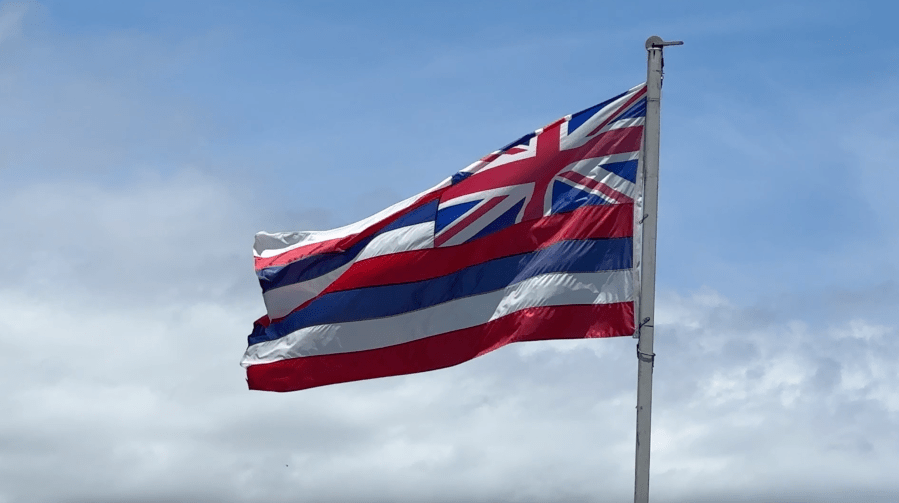
HONOLULU (KHON2) – In the ahupuaʻa of Honouliuli, which lies in the moku of ʻEwa here on Oʻahu, stands a roadway which brings our attention to our flag.
We are speaking of Puwalu St.
In Hawaiian, the word puwalu can mean “all together or in unison,” but it also means “flag, as on a pole.”
The first flag to Hawaiʻi was around 1794 when Chief Kamehameha voluntarily ceded to Great Britain.
He was gifted the red ensign, an all-red flag with the Union Jack in the canton used by the British Merchant Navy.
From then, for over two decades, it was the Union Jack of Great Britain that was flown as the national flag of Hawaiʻi.
In 1816, the King Kamehameha I then adopted a flag with nine horizontal stripes alternating from red, white and blue, and the Union Jack in the canton.
The flag of the Hawaiian Kingdom adopted in 1816 by King Kamehameha I was similar to the Hawaiʻi State flag today.
It was the Paulet Affair, which led to Lā Hoʻihoʻi Ea recognized here at Thomas Square, which led King Kamehameha III to redesign it.
Being convinced that he needed to rebuild his defenses, King Kamehameha III altered the Hawaiian flag in 1845.
He reduced the number of horizontal stripes from nine to eight, reflecting the number of major islands in the Hawaiian Kingdom.
This was the pattern that became the flag for Hawaiʻi as a US Territory and then became the State flag after 1960.
Rumors share of a popular modern flag reflecting nine stripes alternating from green, red, and yellow as the original Hawaiian flag.
Those rumors are false as there is no historical evidence found of to prove that claim.
Did you know? Now you do!