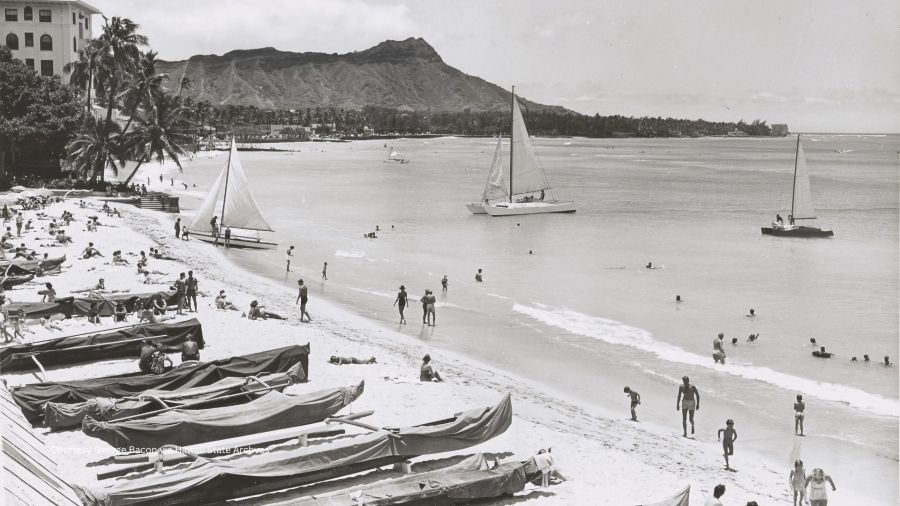
HONOLULU (KHON2) — Waikīkī Beach in the 21st century is full of high-rise hotels, restaurants, surf lessons and packed beaches mostly filled with tourism visitors. But 70 to 80 years ago, the entire area of Waikīkī looked very different.
Thanks to a project by the Hawaiʻi State Archives, we now have a closer look at what Waikīkī was like in the 1940s and early 1950s. And what we see is a place that began to grow very quickly.
Thousands of historical photos are now online that show everything from beachgoers and buildings to boats and parades.
These images help tell the story of a place that has changed over time but still holds the same name and ocean breeze.
While most of these photos are from the state’s archives, we leaned on Getty Images to give us some of the 1950s photos as a means of showing the growth Waikīkī experienced in tourism after World War II.
-

Waikiki Beach in Honolulu, Hawaii on the island of Oahu with Leahi (a.k.a. Diamond Head) in the background, circa 1949. (Photo/George Bacon via Hawaii State Archives) -

Moana Hotel Waikiki Beach in Honolulu, Hawaii on the island of Oahu between 1948-1954. (Photo/George Bacon via Hawaii State Archives) -

Aerial view of Waikiki in Honolulu, Hawaii on the island of Oahu between 1948-1954. (Photo/George Bacon via Hawaii State Archives) -

Aerial view of Waikiki in Honolulu, Hawaii on the island of Oahu between 1947-1954.(Photo/George Bacon via Hawaii State Archives) -

Waikiki Beach in Honolulu, Hawaii on the island of Oahu with Moana Hotel in the background, circa 1946. (Photo/George Bacon via Hawaii State Archives) -

Waikiki Beach in Honolulu, Hawaii on the island of Oahu with Leahi (a.k.a. Diamond Head) in the background, circa 1949. (Photo/George Bacon via Hawaii State Archives) -

Waikiki Beach in Honolulu, Hawaii on the island of Oahu, circa 1949. (Photo/George Bacon via Hawaii State Archives)
The images show familiar places, but they look quieter and simpler than what many people expect. Some show wide stretches of beach with few people while others demonstrate the amount of beach erosion Waikīkī has experienced over the last century. Meanwhile, other photos show landmarks before major development began.
-

Shoppers outside the ‘International Market Place’, where wares from across the Pacific Islands are on sale, in the Waikiki district of Honolulu, on the south shore of the Hawaiian island of O’ahu, Honolulu, Hawaii, circa 1955. (Photo by Werner Stoy/Camera Hawaii/FPG/Archive Photos/Getty Images) -

A view along Waikiki Beach showing (l-r) the Outrigger Canoe Club (with the Princess Kaiulani hotel behind), the Moana Hotel, and a section of the Surfrider Hotel, Honolulu, Hawaii, circa 1952. (Photo by Werner Stoy/Camera Hawaii/FPG/Archive Photos/Getty Images) -

Buildings, including the Foster Tower Hotel, are illuminated with the silhouette of Diamond Head in the background, and Waikiki Beach to the right of the frame, and the Ala Moana Center shopping mall in the foreground, in the Waikiki neighbourhood of Honolulu, on the island of Oʻahu, Hawaii, circa 1955. (Photo by John Titchen/Three Lions/Hulton Archive/Getty Images) -

A man pushes a woman out to sea on a surf board, Waikiki Beach, Honolulu, Hawaii, USA, circa 1955. (Photo by Pictorial Parade/Archive Photos/Getty Images) -

US Servicemen and their families relax on the stretch of land beside Waikiki Beach, land owned by United States military reservation Fort DeRussy, in the Waikiki neighbourhood of Honolulu, on the island of Oʻahu, Honolulu, Hawaii, circa 1955. (Photo by John Titchen/Three Lions/Hulton Archive/Getty Images) -

Sailors mill outside of Waikiki theater block on quiet street with parked cars and palm trees, in Honolulu, Hawaii, circa 1950s. (Photo/Getty Images) -

Two sailors walk in uniform on Waikiki
Beach in Honolulu, Hawaii on the island of Oahuy, circa 1950s with Leahi (a.k.a. Diamond Head in background. (Photo/Getty Images) -

Men in bathing suits walk near surf with buildings lining Waikiki Beach. in Honolulu, Hawaii, circa 1950s. (Photo/Getty Images) -

Men in bathing suits walk near surf with buildings lining Waikiki Beach. in Honolulu, Hawaii, circa 1950s. (Photo/Getty Images) -

Outrigger Waikiki on the Beach, a club and hotel in Honolulu, Hawaii, circa 1930-1960. (Photo by Adrian Ace Williams/Archive Photos/Getty Images) -

(Original Caption) Soldiers Help Celebrate Hawaii’s Flag Day Festivities. Waikiki, Hawaii.: The hope of reaching statehood some day was the fundamental thought in Hawaii’s flag day festivities. At Waikiki anti aircraft artillery man Winkler and Naval Air station man Nash conduct a private parade of their own with Emmaline Correa, left and Lolita Kahele. The girls are garbed in typical Hawaiian mode. -

(Original Caption) Stage and screen star Henry Fonda seems to have the knack as he tries a surfboard at Waikiki in Honolulu, Hawaii, circa 1955. The well-known performer is filming Mister Roberts which he did on the Broadway stage. (Photo/Getty Images) -

Sunbathers and holidaymakers, a group stand around an outrigger boat, on the shore of Waikiki Beach in Honolulu, Hawaii, with the volcanic cone Diamond Head in the background, in Honolulu, on the island of Oʻahu, Hawaii, circa 1955. (Photo by Three Lions/Hulton Archive/Getty Images) -

View over the heads of the audience towards the stage with a hula show in progress at the Waikiki Shell, an outdoor concert venue, in Kapiolani Park, in the Waikiki district of Honolulu, on the south shore of the Hawaiian island of O’ahu, Honolulu, Hawaii, circa 1957. The amphitheater’s seashell design was designed by American architect Lewis P Hobart. (Photo by FPG/Archive Photos/Getty Images)
This digitization project has one of several happening as the state’s archives have been growing and stretching their reach under the direction of Dr. Adam Jansen.
You can click here to see more of the State Archives have to offer.
The State Archives is also working on a large Hawaiian music collection with more than 20,000 pieces, including some of the rarest ukulele in the world.