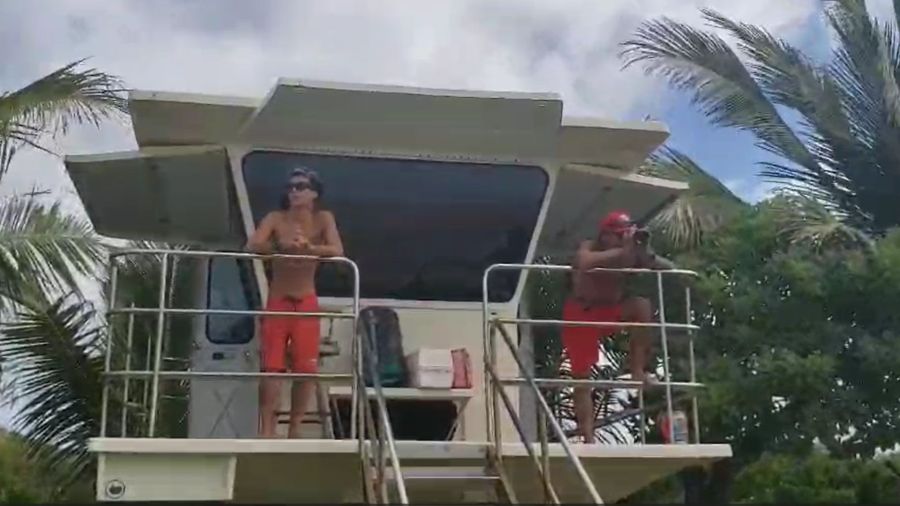
HONOLULU (KHON2) — It’s time for another episode of The Unfit Adventurer. On Tuesday, July 22, we visited one of Oʻahu’s most dangerous beaches, Sandy Beach. We spoke with Peter Erwin, acting lieutenant for the newly minted agency, Honolulu’s Ocean Safety regarding surf, swells and why some beaches are not for beginners, especially in Hawaiʻi.
“It definitely is,” Lt. Erwin said when asked if Sandy Beach was one of the most dangerous. “We have our challenging conditions down here, and conditions are changing every day.”
Lifeguards at Sandy arrive each morning and begin watching the ocean.
“We’re looking for sand movement, wave direction, swell direction and wind direction because all of that stuff makes a huge difference in what’s going to happen down here,” Lt. Erwin said.
Waves might look fun to someone standing on the sand, especially visitors who are unfamiliar with Hawaii’s wave and surf patterns. But not everything is what it seems.
“[Visitors] look at it like it’s a whole bunch of fun and a water park when they see some younger kids, some older gentleman and older women that are down here’ and they are, like, ‘wow, this looks great’,” Lt. Erwin said. “Unfortunately, those people that they’re seeing have a lot of experience and have been coming down here for years.”
He said even as a local kid, he didn’t start surfing Sandy Beach until he was older.
“It is a process,” Lt. Erwin said. “Me growing up here, I didn’t come to Sandy until I was mid-teens.”
The most important thing you can do at a Hawaiʻi beach
“The best thing to do is we just have the best local knowledge up here,” Lt. Erwin said. “Check in with us, the lifeguards.”
He said visitors should not be afraid to talk to lifeguards.
“We love the people coming up because it gives us an opportunity to educate them and that education can go a long way for their whole trip,” Lt. Erwin explained.
Lifeguards help beachgoers learn how to “time the waves, how to look for the currents if you’re going to go in the water and what areas the currents are going to be in, and more importantly, how to get out of the currents,” Lt. Erwin said.
A heavy day of rescues
Days at Sandy Beach can vary. But when things get busy, they get busy fast.
“We’ve had days where we can have anywhere from two rescues to 15 a day,” Lt. Erwin said. “You can add that up over a year. We kind of lose count.”
He said Sandy Beach’s short coastline and direct exposure to deep ocean swell make it more intense than other locations.
“This is the first coast that it’s hitting,” Lt. Erwin said. “There’s just so much energy and not much place for the water to go.”
But Ocean Safety’s lifeguards train for that.
“We’re heavy on the prevention,” Lt. Erwin said. “We really work hard and make sure we identify people that we may think are not from the area, and we let them know the conditions and not to go in if they aren’t experienced.”
Lt. Erwin said that across Oʻahu, the numbers of rescues and preventions add up fast.
“You can have multiple rescues per day; and maybe, in a year, it can be in the hundreds,” Lt. Erwin said. “We’re also preventing, you know, like, 50 to 80,000 preventative rescues.”
Where to go instead
For beginners or families, Lt. Erwin recommended beaches with calmer conditions.
“We recommend just around the corner, we have Kailua Beach and Waimānalo Recreational Bay,” Lt. Erwin said. “Those beaches still have their own dangers, but it’s just not as dangerous as [Sandy].”
He said those beaches have outer reef barriers that help to calm the waves before they reach the shore.
You can click here to learn more about Ocean Safety. You can also click here to see where Oahu’s lifeguard towers are located.
“When it comes into the shore break, it’s not as strong,” Lt. Erwin said. But even there, currents still exist. And the advice remains the same. “Just check in with those guys,” Lt. Erwin said as he pointed to Honolulu’s brave lifeguards.
Whether you’re a local, resident or visitor, ocean safety is one of the most important learning curves the islands have. So, be safe and get to know your local lifeguards. It could save our life.