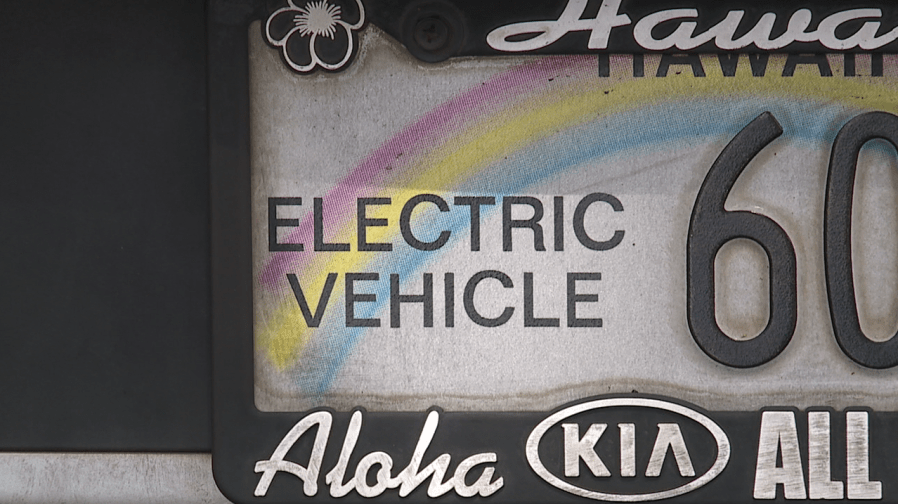
HONOLULU (KHON2) — Starting July 1, Hawaii will launch a shift in how electric vehicle drivers pay for road upkeep–swapping the traditional gas tax for a new road usage charge, based on how many miles you drive.
EV drivers will have a choice of paying eight cents per mile traveled or pay a flat fee of $50, paid for at the time of your safety inspection.
Then in 2028, all EV drivers will be required to pay $8 per 1,000 miles, with a maximum of $50 a year.
“When we start looking at the cost of owning an electric vehicle, this is less than 1% of your cost, the 16 cents that you would save or not save on that portion. The larger discussion, though, is we’re still going to need funding to take care of our roads and bridges to ensure that we have continuous and safe connectivity throughout the state,” said Ed Sniffen, Hawaii Department of Transportation director.
“We’re supportive of the intention. We just need to make sure that one, it’s communicated correctly with our current EV owners, and then two, that it’s communicated accurately and effectively to all of our residents so that this doesn’t turn into a sort of like a deterrent for EV adoption,” said Noel Morin, president of the Hawaii Electric Vehicle Association.
But now a second charge may be on the way. House Bill 1161 is moving into conference. It allows individual counties to add their own mileage-based fee, aimed at funding local infrastructure needs. The money would be collected at the time of registration and go into a county highway fund.
“If we’re not cautious about how we execute it, especially at the county level, is that you could disproportionately impact low, moderate income households, or folks that live in very rural, rural areas in this county and counties across the state,” Morin said.
According to recent state data, as of March 2025, there were 36,856 registered EVs in Hawaii, an increase of 5,797 vehicles compared to last year. EVs represent about 3% of all registered passenger vehicles in the state.
Morin says the state shouldn’t lose sight of the bigger picture– that reducing fossil fuel use is about more than just switching to electric cars.
“It’s not just about maintaining the vehicles that you have today, and converting them over to something more efficient. It’s also reducing the number of miles driven, reducing the number of cars that are required to begin with,” Morin said. “We may need to diversify and look for other ways to fund the infrastructure. It may not always be just road use or the weight tax.”
The HDOT director agrees, and said transportation is just one piece of a much larger climate puzzle.
“We’re resetting our system to ensure that we have connectivity between all of our bike and pet paths in the next five years, and that’s just an alternative thing, getting people more options to move to hopefully get them to drive less,” Sniffen said. “One of the bigger pieces is we’ve got to reset what our land use looks like, making sure that we have more opportunities in areas where people live.”
There is a public hearing on the administrative rule changes on the road usage charge on May 13. This is the first step in reaching a state mandated deadline of converting all vehicles to the road usage charge by 2033.