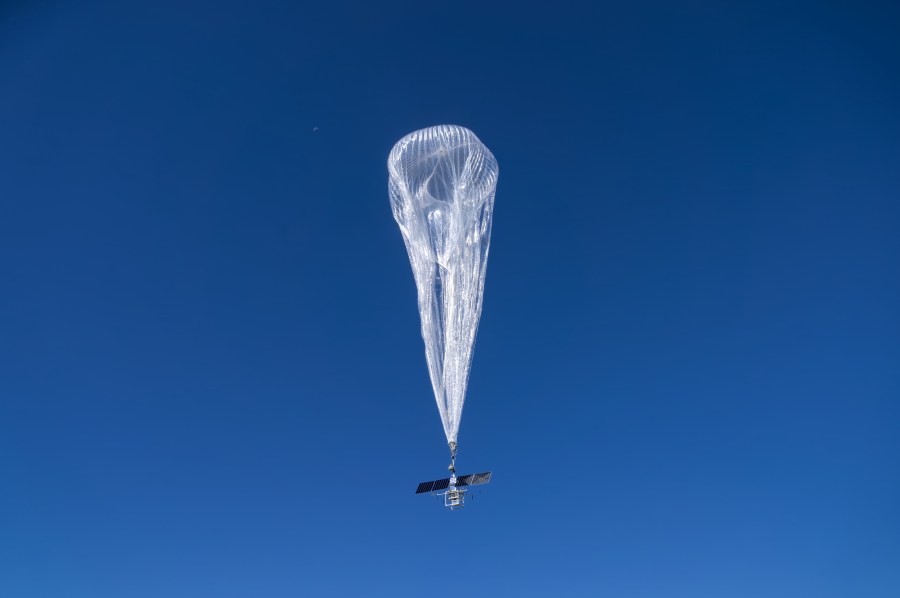
HONOLULU (KHON2) — Over the last several weeks, KHON2 received numerous calls and e-mails about a balloon flying high over Oahu and Molokai.
“Around 10 this morning up Maunalani Heights we saw something, it was stationary, not moving at all and no sound. It was high altitude and we didn’t know what it was,” said Oahu resident Ken Inouye. “We were wondering could it be foreign matter? Or weather maybe?”
The balloon was able to be tracked on Flightradar24.com and found its registration number and eventually the owner, Aerostar, which is located about 4,000 miles away in Sioux Falls, S.D.
“No, it’s not a UFO, it’s pretty well identified, and it’s not Chinese,” said Russ Van Der Werff, vice president of stratospheric solutions at Aerostar. “It’s from South Dakota.”
He said the balloon left Sioux Falls about two months ago and has been flying around the islands the last few weeks and is currently in research and development, or “R and D,” mode.
“There’s a lot of problems out in the Pacific region that are unique, whether it be weather monitoring or illegal fishing, even some of the natural disaster stuff, doing damage assessment, communications, monitoring, wildfires and things, so we’ve got a lot of people interested out there and we like to put stuff up where people are interested when we’re doing R and D, just to show them what we’re capable of,” Van Der Werff added.
Unlike a satellite which goes around earth once or twice a day, these balloons can stay over a specific area for long periods of time. Right now, it’s traveling at about 10 to 15 miles per hour in the stratosphere.
“This is all something that we can remote control from the ground through a computer, and we’re always coordinating in real time with air traffic control regional military authorities,” Van Der Werff explained.
The balloon runs on solar energy which is being fed into the batteries to keep it going.
“The helium is sealed inside the balloon that provides a lift and then to steer the balloon, we use the winds that are up there in the stratosphere at different altitudes and we have a computer machine learning model that’s pulling in lots of weather data, and it’s assessing what direction the wind will be going at those different altitudes,” he added.
Similar to a sailboat, the balloon can be raised or lowered to catch the wind going in the direction they want it to go.
Recently, Aerostar showed the U.S. Forest Service in the western U.S. how they can monitor the progression of new wildfires.
“The guys on the ground who are trying to fight these fires, you know, they can see on their phone, which is connected up to the balloon, where they’re at, where the fire is at, how things are moving, which can really be a lifesaver kind of deal in that situation,” Van Der Werff added.
The balloon has been seen mostly around Molokai and Oahu.
Aerostar says it’s about 70 feet in length and hovering about 50,000 to 100,000 feet in the air.
The company said the balloon has about three months of life in it before heading back to South Dakota.
Van Der Werff added that Aerostar has been around since 1956, and was around even before NASA. The company has been helping with the space race decades ago and works with NASA on several projects to date.
The company has been working with Google on a project called ‘loon’ for about 15 to 20 years which does cellular connections from balloons.
Last month the company set a world record with the longest continuous flight in the stratosphere by a controllable flight vehicle. It stayed in the air for 336 days and traveled over 80,500 nautical miles from Florida, to the Caribbean, to the Midwest, to Hawaii and south across the Equator to the South Pacific.