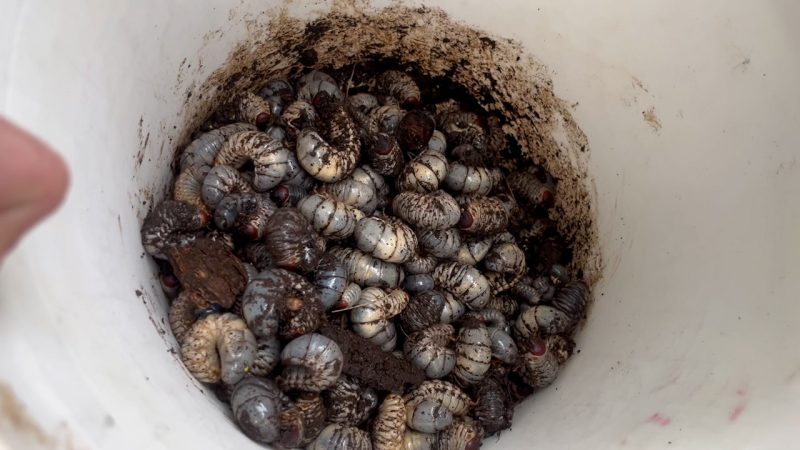
HONOLULU (KHON2) — The Coconut Rhinoceros Beetle is making its way to town.
Experts said the last sightings of the beetle near Waikiki was 10 years ago, and now trees near Ala Moana are showing signs of damage.
Experts said that’s a concern because the beetle can travel about two miles.
The CRB Response Team said it spotted new and old damage on palms near the new pedestrian bridge on Ala Moana Blvd, on the public end of the bridge. Although the beetle doesn’t prefer urban settings, experts say it’s likely brought to town via new development and landscaping.
“We were expecting CRB to show up in town, eventually,” said Michael Melzer, researcher at the University of Hawaii’s Tropical Agriculture and Human Resources. “We were hoping it was going to be longer before it started making its way in. Unfortunately, it’s here.”
He said people will start to see damage in areas like Ala Moana and Waikiki, but it won’t be as dramatic as places like North Shore.
Experts say it can take six months to see signs of damage, like the “v’s” in the palm fronds, and two to three years for heavy infestations. However, the beetles don’t prefer town to begin with.
“They need mulch piles, decaying stumps, decaying plant materials to go through its life cycle, and it needs moisture,” explained Keith Weiser, UH CRB Response Deputy Incident Commander.
Since town is mostly buildings and parking lots, they say it’s hard for the beetle to establish a breeding ground, unless it’s brought in.
Workers for a new Ala Moana development off Keeaumoku were seen placing palm trees with CRB damage, including bore holes and V-shaped palms.
KHON2 reached out to the company for comment which said the project manager told them they are treating the trees prior to delivery and installation, and currently working on getting the trees treated.
KHON2 asked if the beetles will eventually reach Waikiki.
“We have caught beetles in Waikiki, it’s unclear whether a breeding population has established there,” Weiser explained.
“But at the ends of Waikiki, you have Kapiolani Park on one side and some natural areas with Ala Moana Park on the other side,” he continued. “If those parks have accumulations and stumps and things you could see [beetle] populations on either end so I think being cognizant of breeding materials in Waikiki that’s going to dictate a lot of the populations out there.”
“Town is actually our greatest concentration of palm trees,” explained Honolulu Department of Parks and Recreation spokesperson Nate Serota.
The city said it’s been trying different treatments to combat CRB from netting, to prohibiting new palms, spraying pesticides and injections. He said there are pros and cons to each, but in the end, there are more palm trees than workers, and it comes down to funding as well.
“In a lot of cases, we’re not necessarily able to treat the palms impacted because we have thousands of palms in our inventory,” he explained. “It’s very labor-intensive and we just can’t get to every single tree, really CRB is ahead of what a lot of our efforts are at this point.”
He said for now, south shore parks are mostly CRB-free, but private areas nearby show signs of damage.
Check out more news from around Hawaii
“CRB doesn’t care about jurisdiction, it’s going to go to whatever palm it can to feed, infest, and kill the tree,” he added.
He along with the CRB Response said it will be a team effort between private landowners, the city, and the state to stop the beetle from destroying the rest of Oahu’s beautiful scenery.