HONOLULU (KHON2) — By sea or by air, illegal fireworks continue to make their way into Hawaii. But efforts are ramping up to catch them, and keep ships and planes safer in the process.
While most of the contraband is still through Hawaii’s ports, what’s coming by air raised alarm bells at a legislative briefing this month. Always Investigating wanted to know what’s being done about it.
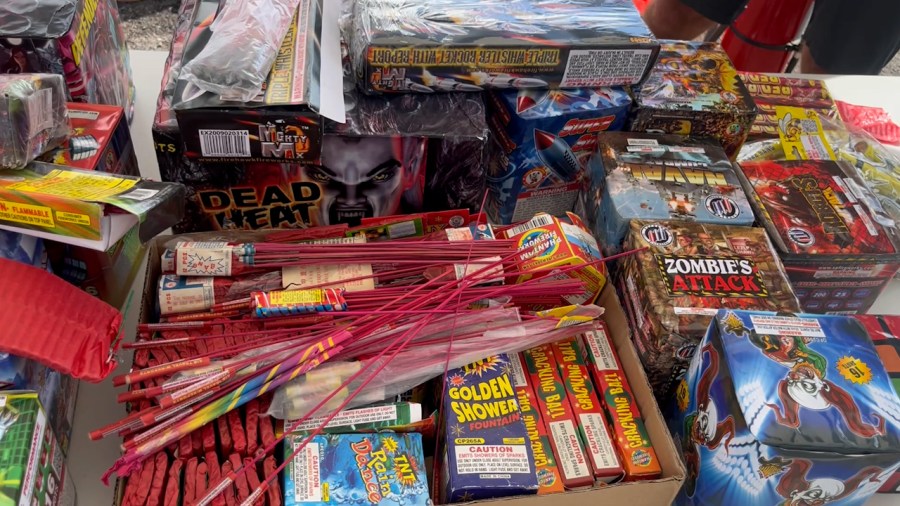
Aerial fireworks that light up the night sky come from a steady stream of illegal shipments. A state special enforcement unit caught hundreds of thousands of pounds, but that dwindled to tens of thousands intercepted.
Hawaii’s former Law Enforcement Director, Jordan Lowe, explained at a recent legislative briefing, “If they figure we found out their method of smuggling, they’re going to adjust their method of smuggling. Now we have to adjust our strategy to catch them.”
So if not by sea, some fireworks come by air.
“We’re catching daily, almost daily, parcels from the USPS containing 80, 100 pounds, maybe 200 pounds of fireworks at a time and those are coming on our commercial planes,” Lowe said at the Jan. 7 briefing.
When asked by Sen. Karl Rhoads if this is something to ‘lose sleep’ about, Lowe offered an interesting response.
“I would be concerned,” Lowe said. “It’s a bad day if you have fireworks going off in the cargo hold of your plane.”
Leadership at the Department of Law Enforcement has changed since that briefing, and DLE declined to have the newly appointed director address our follow-up questions, so we asked the U.S. Postal Inspector and the Department of Transportation what’s going on with daily fireworks busts on air cargo.
“I think it’s a bit of an overstatement,” said Ed Sniffen, director of the Department of Transportation. “Our law enforcement does a really good job of identifying these pieces that are of concern and pulling them off, whether they’re fireworks or guns or drugs. Maybe that’s what our law enforcement brethren were talking about when they say every day. But from what we understand, fireworks are not an everyday occurrence.”
U.S. mail and private-company parcels come on all manner of flights, whether in the cargo hold of passenger planes or on cargo-only flights. However, Amanda Jagusiak, a spokesperson for the U.S. Postal Inspection Service said that not all flights bound to the islands has mail on it.
“But the flights that do have mail on it have extra security procedures, extra precautions to make sure that those parcels and packages are safe for travel, safe for being in the air,” Jagusiak said.
There are different levels of screening for cargo-only flights, but what about when parcels and passengers are sharing a plane?
“I’m 100 percent certain that everything that goes on passenger planes gets screened and there are protocols and policies in place that absolutely control everything that goes on there,” Sniffen said. “So whether it’s TSA or whether it’s USPS that has their own EDS or explosive devices, everything gets screened by machine or by dog before it goes on a passenger plane. So the public should be 100 percent secure that they’re not going to be sitting over fireworks on the plane.”
That said, the postal inspectors say don’t even try to airmail fireworks. They’re dangerous and come with criminal charges and fines up to $100,000. USPIS offers a $250,000 reward for tips that lead to convictions of people who mail bombs and explosives, and both the sender and recipient can be charged.
“There has been in the past arrests at all stages of the process,” Jagusiak said. “I can’t say if there’s about to be. I can say that there are active investigations ongoing. Postal Inspectors work with ATF and state and local officials on the mainland and in Hawaii to keep the mail stream safe.”
The Department of Transportation says the lion’s share of fireworks still comes by ship.
“If we’re looking at making sure that we stop it in mass, it’s at the ports that we’re going to be focusing,” Sniffen said.
But whether sea or sky, a multiagency effort is working on keeping them out.
“We’re aligning all of our enforcement here first,” Sniffen said. “So we’re adding more dogs to our sheriff’s teams to ensure that we have we have more of those potentials to capture here, and not just at the airport, at our ports as well, working with them to see what kind of scanners make the most sense.”
Officials say it would help a lot if the public stops buying it all.
“There’s a lot who believe that it shouldn’t be banned in the first place, and there’s a lot who partake in it,” Sniffen said. “We’ve got to stop that. It’s illegal. We if we stop the demand, the supply doesn’t come in anymore.”