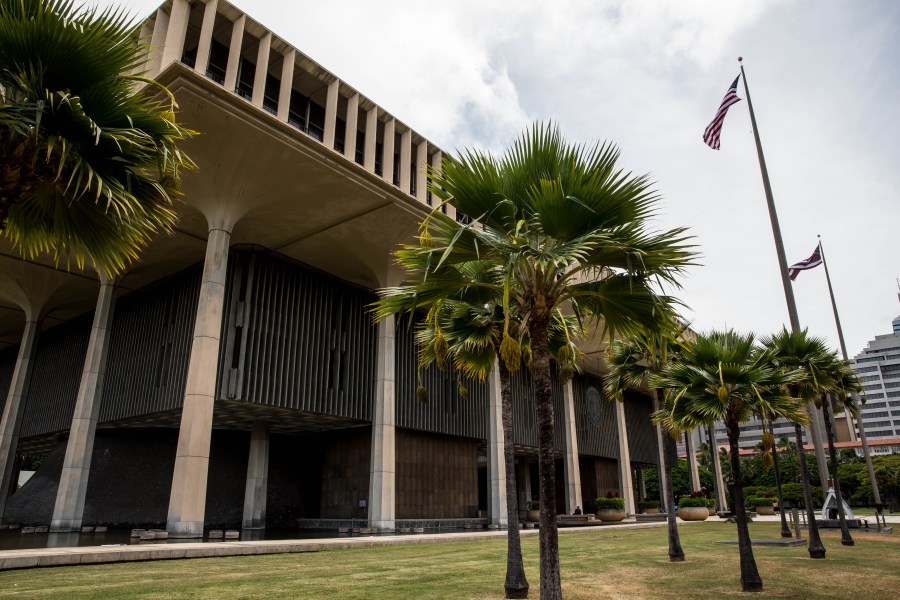
Vice Speaker Linda Ichiyama joins producer/host Coralie Chun Matayoshi to discuss key bills that passed this legislative session, including House Majority Package bills (involving housing, homelessness, agriculture, economic development, and public safety), fireworks, landfill placement, condominium insurance rates, HECO securitization, and regulation of midwives. The Governor’s deadline to veto any of the bills passed is July 9, 2025.
Linda Ichiyama is an attorney who has served in the Hawaii State Legislature for 15 years and represents the Moanalua, Salt Lake and Aliamanu areas.
Notable bills that passed:
2025 HOUSE MAJORITY PACKAGE – all 7 bills now either passing final reading in both legislative chambers, adopted through companion legislation, or funded through the state budget. All measures now await the Governor’s signature.
Renames the Department of Agriculture to the “Department of Agriculture and Biosecurity”. Renames the Board of Agriculture to the “Board of Agriculture and Biosecurity”. Establishes and appropriates funds for a Deputy Director of Biosecurity. Changes references to the plant and animal declaration form to the “biosecurity form”. Authorizes and specifies conditions under which the Department of Agriculture and Biosecurity may declare a biosecurity emergency, during which the Department and Governor may take certain actions to prevent the establishment or spread of pests and prohibited or restricted organisms. Broadens the objectives and general actions of the Biosecurity Program. Appropriates funds for positions for the Department of Agriculture and Biosecurity. Appropriation: $12,735,015 for FY26, $12,735,015 for FY27, plus $589,716 for Biosecurity FTE and additional funding – recurring.
Establishes the Hawaiʻi Farm to Families Program to alleviate food shortages in the State. Requires reports to the Legislature prior to the Regular Sessions of 2026 and 2027. Appropriates funds. Funded in the State Budget (HB300): $500,000 in FY26 and FY27.
Appropriates funds to hire teachers and teacher assistants and for equipment and services for public preschools. Funded in the State Budget (HB300): $5,027,927 and 58 FTEs in FY26, and $8,236,302 and 108 FTEs in FY27.
Permits the Department of Labor and Industrial Relations to enter into contracts with eligible employers or registered apprenticeship programs in the private sector to provide on-the job training to eligible interns. Provides that the State shall be the responsible employer for purposes of workers’ compensation coverage for students or recent graduates in the on-the-job-training work experience program, subject to certain limitations. Appropriates funds. Appropriation: $1.8 million for FY26 and $1.8 million for FY27; supports 90 DOE FTEs.
Appropriates funds for the Kauhale Initiative to house and provide services to homeless residents. Appropriates operating funds for established Kauhale and for new Kauhale planned as Capital Improvement Projects. Makes permanent the Ohana Zones pilot project and appropriates operating funds. Sets reporting requirements for the programs. Appropriation: $18,575,000 for FY26, $24,325,000 for FY27 (Kauhale Initiative), and $2,525,000 for FY26 and $5,855,000 for FY27 (Continued Ohana Zones Pilot Program). Capital Improvement Project budget for new construction of Kauhale: FY26 $25,400,000 and FY27 $13,000,000.
Establishes the mixed-income subaccount within the Rental Housing Revolving Fund that targets workforce rental housing projects for persons and families with incomes at or below one hundred forty percent of the area median income. Authorizes the Director of Finance to transfer funds from the Rental Housing Revolving Fund into the mixed-income subaccount. Appropriates funds into and out of the mixed-income subaccount of the Rental Housing Revolving Fund. Did not pass but the concept was adopted and funded in HB1409 to create the Mixed-Income Subaccount in the Rental Housing Revolving Fund. Funded in the State Budget (HB300): $50 million in CIP funding for Tier II workforce housing to the Rental Housing Revolving Fund for FY26 and FY27.
Appropriates funds to the Department of Corrections and Rehabilitation for reentry services to connect offenders with community-based services. Funded in the State Budget (HB300): $4 million for FY26 and $4 million for FY27.
FIREWORKS
- HB 806 – Appropriates funds to the Department of Law Enforcement to conduct fireworks sting operations and establish an explosives and firearms laboratory. (CD1)
- HB 550 – Allows recordings made by law enforcement agencies who are using, controlling, or operating unmanned aerial vehicles to establish probable cause for arrests under the Fireworks Control Law if the unmanned aerial vehicle is recording directly above public property and the act leading to the arrest is committed on public property. (CD1)
- HB1483 – Establishes various criminal offenses and penalties related to fireworks or articles pyrotechnic. Amends multiple definitions and penalties for fireworks offenses, including heightened penalties if another person suffers substantial bodily injury, serious bodily injury, or death as a result of the fireworks offenses. Adds fireworks infractions to the existing adjudication of infractions process for traffic and emergency period infractions. (CD2)
LANDFILL LOCATION
- SB 969 – Prohibits landfill units on land in an agricultural district with class A soils in a county with a population greater than five hundred thousand. Beginning 7/1/2025, narrows the prohibition on constructing, modifying, or expanding waste or disposal facilities within a one-half mile buffer zone of residential, school, or hospital property lines to apply specifically to landfill units or components of landfill units. Beginning 7/1/2025, prohibits the construction, modification, or expansion of a landfill unit, or any component of a landfill unit, inland of an underground injection control line in a county with a population greater than five hundred thousand, with certain exemptions. (CD1)
CONDOMINIUM INSURANCE
- SB 1044 – Expands the powers of the Hawaii Property Insurance Association and reactivates the Hawaiʻi Hurricane Relief Fund to help stabilize the property insurance market in the State. Establishes the Condominium Loan Program and the Condominium Loan Revolving Fund, to be administered by the Hawaiʻi Green Infrastructure Authority on behalf of the Department of Business, Economic Development, and Tourism, for the purpose of providing financing for essential repairs and deferred maintenance to condominium associations. Abolishes the Condominium Loan Revolving Fund on 6/30/2047. Establishes the Condominium Loan Loss Reserves Program to incentivize lenders to provide loans at competitive rates and terms to allow condominium associations to make necessary maintenance and repairs. Requires the Insurance Commissioner to conduct a study to develop long-term solutions to help stabilize the property insurance market in the State. Requires reports to the Legislature. Authorizes the issuance of reimbursable general obligation bonds to facilitate the initial issuance of policies to condominium associations. Appropriates funds. (CD1)
- SB 897 – Allows electric cooperatives to recover wildfire mitigation, repair, and restoration costs through an automatic rate adjustment or other mechanism. Requires the Public Utilities Commission to initiate a proceeding for the adoption of rules, subject to the Governor’s approval, to determine an aggregate limit for liability for economic damages from a covered catastrophic wildfire. Authorizes securitization of certain costs for electric utilities. Requires the Public Utilities Commission to conduct studies on whether the framework established in the measure adequately balances electric utility interests and compensation owed to catastrophic wildfire victims and on the establishment and implementation of a wildfire recovery fund and report its findings and recommendations to the Legislature. Appropriates moneys. (CD1)
MIDWIFERY REGULATION
• HB 1194 – Makes laws regulating midwives and the practice of midwifery permanent. Clarifies the scope of practice of midwifery. Establishes licensure requirements for certified midwives and certified professional midwives. Establishes continuing education requirements. Grants global signature authority to midwives. Grants prescriptive authority to licensed midwives practicing as certified midwives and amends the list of approved legend drugs that may be administered by midwives. Establishes peer review and data submission requirements. Affirms that the practice of midwifery does not include Native Hawaiian traditional and customary practices. Clarifies exemptions from licensure and grounds for refusal to grant, renew, reinstate, or restore licenses or for revocation, suspension, denial, or condition of a license. Clarifies medical record availability and retention requirements for the purposes of medical torts. (SD3)
Notable bills that didn’t pass:
ASSAULT WEAPON BAN
- SB 401 – Establishes prohibitions on assault rifles, assault shotguns, and .50 caliber firearms. Expands the ban on high-capacity detachable magazines. Allows possession of an assault rifle, assault shotgun, or detachable magazine with a capacity greater than ten rounds when certain conditions are met. Effective 1/1/2026. (CD2)
- HB 392 [SIGNED INTO LAW] – Prohibits the possession, transfer, and sale of ghost guns. Establishes mandatory minimum sentencing for use of a ghost gun in the commission of a felony. (HD1)
RECREATIONAL MARIJUANA
- SB 1613 – Establishes the Hawaiʻi Cannabis and Hemp Office within the Department of Commerce and Consumer Affairs to regulate all aspects of the cannabis plant. Beginning 1/1/2026, legalizes the personal adult use of cannabis. Establishes taxes on the retail sale of adult-use cannabis and the sale of medical cannabis. Adds new traffic offenses relating to the consumption or possession of marijuana or marijuana concentrate. Makes conforming amendments related to the legalization of personal adult use of cannabis. Beginning 1/1/2026, decriminalizes certain drug offenses related to marijuana and marijuana concentrate. Transfers the personnel and assets of the Department of Health and assets of the Department of Agriculture relating to cannabis to the Hawaiʻi Cannabis and Hemp Office. Establishes various positions within state entities to regulate the personal adult use of cannabis. Approp
GAMBLING
- HB 1308 – Allows for the regulation of sports wagering by the Department of Law Enforcement. Establishes licensing requirements for sports wagering operators and sports wagering suppliers. Establishes a general excise tax to be levied on sports wagering operator licenses. Establishes the Problem Gambling Prevention and Treatment Special Fund to be administered and expended by the Department of Health. Specifies that legal sports wagering and fantasy sports contests shall not be considered contests of chance or gambling. Authorizes DLE to perform criminal history record checks on applicants and licensees relating to sports wagering